
Samples / NURS FPX 4025 / Assessment 4
Presenting your PICO(T) process findings to your professional peers
Visual Preview
Click the preview to enlarge it. The sample text continues below.
NURS FPX 4025 · Assessment 4
Sample for study and reference. Ace My Assessment is an independent academic support service.
Introduction
Hi, I am a registered nurse, and today I will be presenting my evidence-based findings on post-operative hip arthroplasty nursing care.
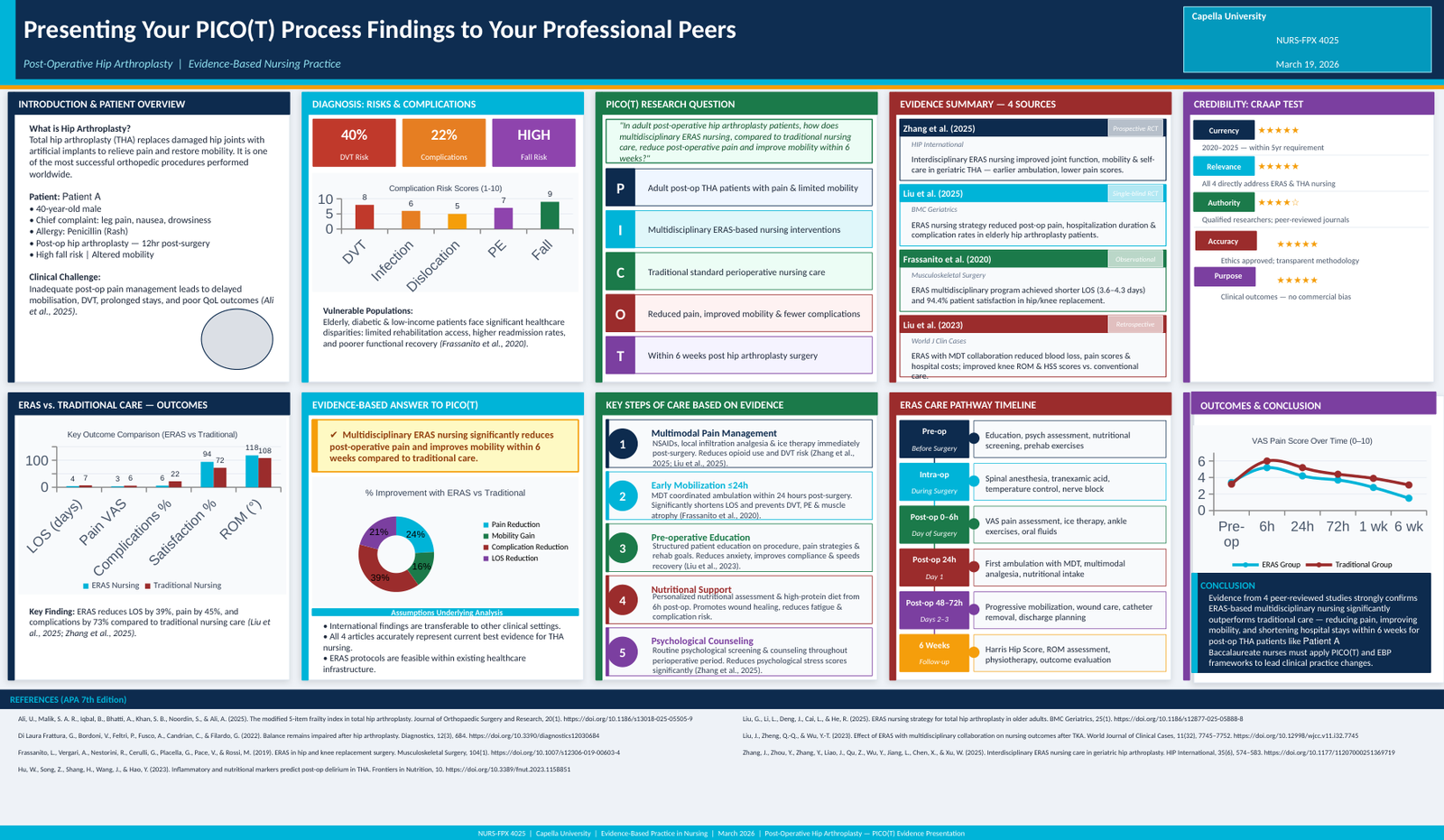
Hip replacement (hip arthroplasty) surgery is one of the most frequently performed orthopedic procedures throughout the world and has a high impact on patient recovery. One of the significant challenges facing nurses is inadequate postoperative pain management, which can negatively impact patient mobility and overall recovery. The purpose of this presentation is to identify evidence-based, multidisciplinary nursing interventions that will promote positive outcomes for patients undergoing hip arthroplasty. Research findings will be presented according to the PICO(T) method and four credible scholarly, peer-reviewed articles (Ali et al., 2025) will provide additional evidence to support these findings.
Diagnosis In Terms of Outcomes, Risks, And Complications
Surgical hip replacement or arthroplasty (AH) is a very important orthopedic surgery done to help individuals obtain freedom from pain in their hip and regain their ability to move around and perform activities of daily living (ADLs) independently. The patient, Patient A, is a 40-year-old man who experienced leg pain, nausea, drowsiness, and an inability to move his legs after surgery for an artificial hip joint replacement. Outcomes expected from this surgery are improved functionality of his hip, decreased pain, and improved ability to live independently after surgery. If a patient does not receive appropriate evidence-based nursing care, they can develop severe complications and prolonged recoveries (Di Laura Frattura et al., 2022).
There are major risks and complications that can occur following hip arthroplasty, including deep vein thrombosis (DVT), infection at the surgical site (SSI), dislocation of the prosthesis, development of a pulmonary embolism (PE), and excessive bleeding. For instance, older patients have an even higher incidence of having a higher risk to fall, a higher incidence of mobility issues than younger patients, and greater incidence of developing complications after surgery. There are many populations who are more vulnerable (e.g., seniors, individuals with diabetes, individuals with no insurance) to healthcare inequality issues. Healthcare inequality limits vulnerable populations’ ability to access quality rehabilitation services and multidisciplinary nursing care (Liu et al., 2025). Vulnerable populations have larger complications, increased length of time in the hospital, and much poorer recovery outcomes overall (Frassanito et al., 2020).
Research Question Development
In adult post-operative hip arthroplasty patients, how does multidisciplinary team nursing intervention based on ERAS, compared to traditional nursing care, reduce post-operative pain and improve mobility within six weeks of surgery?
P (Patient/Population): Adult post-operative hip arthroplasty patients experiencing pain and limited mobility
I (Intervention): Multidisciplinary team nursing interventions based on ERAS concept
C (Comparison): Traditional standard perioperative nursing care
O (Outcome): Reduced post-operative pain, improved mobility, and decreased complications
T (Time frame): Within six weeks following hip arthroplasty surgery
PICO(T) Criteria Analysis
The PICO(T) research question has been designed to identify hip arthroplasty patients specifically as a study population for the purposes of performing evidence-based research. In addition, the PICO(T) research question intends to investigate the effectiveness of ERAS intervention, which involves a team-based approach to nursing care after an operation to the traditional standard of perioperative nursing care (Morris et al.). The desired outcomes of ERAS nursing care interventions include decreased postoperative pain scores and increased functional mobility after surgery, both of which are essential outcomes that signify a successful recovery from hip arthroplasty surgery. The six-week duration established for this study establishes a defined and measurable time frame for assessing the outcomes of nursing interventions (Hu et al., 2023).
Summary of Evidence
Four peer-reviewed publications were selected as evidence for the PICO(T) question related to interdisciplinary ERAS nursing interventions among post-operative hip arthroplasty patients. Zhang et al., (2025) utilized a randomized controlled design to show that an interdisciplinary ERAS nursing methodology would significantly improve joint function, mobility, and self-care of geriatric hip arthroplasty patients. Liu et al., (2023) performed a retrospective chart review, comparing 80 patients who underwent ERAS and engaged in multidisciplinary care and resulted in decreased hospital length of stay, decreased blood loss, reduced pain, and improved functional recovery. Frassanito et al., (2020) describe an ERAS interdisciplinary program including hip/knee replacement where patients had significantly shorter length of stay and 94.4% of patients were satisfied with their care. Liu et al., (2025) published in BMC Geriatrics also performed a single-blind, randomized controlled trial, showing that ERAS nursing strategies reduced postoperative pain, length of stay, and complications for geriatric hip arthroplasty patients. Each of these articles was published in a peer-reviewed journal and came from credible databases (e.g., PubMed, Springer Nature, BMC Geriatrics). These resources are relevant to the PICO(T) question because all of the studies compared interdisciplinary ERAS nursing interventions to traditional nursing care among patients undergoing arthroplasty. Each of the four articles meets the criteria for the CRAAP Test in that they are current, credible, accurate, and appropriate for use as evidence to guide evidence-based nursing practice with hip arthroplasty patients.
Credibility and Relevance
The CRAAP Test indicates that all four articles were evaluated positively for all aspects of the five criteria: currency, relevance, authoritativeness, accuracy, and purpose. Zhang et al. (2025) and Liu et al. (2025) are published in very recently within reputable peer-reviewed journals, which have gone through the full processes of ethical approval and the authors are all qualified. Frassanito et al. (2020) and Liu et al. (2023) come from two very well recognized and trustworthy scholarly databases (Springer Nature and PubMed respectively). All four articles are directly relevant to the nursing care of the post-operative hip arthroplasty patient and provide a strong basis for answering the PICO(T) questions (Zhang et al. (2025), Liu et al. (2025), Frassanito et al. (2020), Liu et al. (2023)).
Evidence-Based Answer to PICO(T) Question
A review of four peer-reviewed studies indicated that multidisciplinary Enhanced Recovery After Surgery (ERAS) nursing interventions provide superior outcomes, including pain reduction and improved mobility, compared to traditional nursing care, for hip arthroplasty patients. Zhang et al. (2025) and Liu et al. (2025) showed that ERAS-based nursing interventions resulted in decreased pain levels, greater joint function, and decreased length of stay in the hospital for patients during the six weeks post-operatively. Frassanito et al. (2020) and Liu et al. (2023) confirmed that ERAS multidisciplinary programs also consistently demonstrate improved patient outcomes compared to traditional nursing care.
Assumptions Underlying the Analysis
The assumption behind this analysis is that results from hospitals around the globe can also be applied to nursing practices conducted in different clinical nursing practice settings and furthermore, that each of the four studies accurately reflects the best available evidence of nursing today (Zhang et al., 2025; Liu et al., 2023).
Evidence-Based Key Steps of Care
Implementation of a structured multi-modal pain protocol in all patients undergoing hip arthroplasty surgery is the first key step, as noted by Zhang et al., 2025; Liu et al., 2025; both groups agree that a combination of non-steroidal anti-inflammatory medications, local infiltration analgesia, and ice therapy can be used to effectively manage postoperative pain. Initiating early mobilization within 24 hours following surgery is the second key step. This should be accomplished through a coordinated multidisciplinary rehabilitation team. Frassanito et al. (2020) demonstrated that early mobilization on postoperative day #1 results in significantly shorter lengths of stays and improved independence and satisfaction rates for patients.
Providing comprehensive preoperative patient education regarding the surgery, pain management strategies, and expected rehabilitation exercises and goals is the third key step. Liu et al. (2023) demonstrated that structured preoperative education significantly decreased patient anxiety, increased patient compliance, and improved overall postoperative recovery outcomes. Implementing nutritional supplements and psychological counseling for patients undergoing hip arthroplasty during the entire perioperative period is the fourth key step. All four of these key steps were chosen as they are supported by the four sources of evidence, and they all agree that comprehensive multidisciplinary ERAS interventions will produce much better results than traditional nursing methods (Zhang et al., 2025; Liu et al., 2025; Frassanito et al., 2020; Liu et al., 2023).
Conclusion
In summary, there is ample support for using ERAS nursing interventions which involve many different disciplines with hip replacement patients who have undergone surgery, like the patient used in the Sentinel U simulation (Patient A). Based on the evidence directly reviewed from the four peer-reviewed articles referenced in this report, ERAS-based nursing has provided a statistically meaningful reduction in post-operative pain, improved mobility, reduction of length of hospital stays, and an overall lessening of complications at 6 weeks post-surgery. Additionally, nurses with baccalaureate degrees will refer to evidence-based nursing frameworks, such as PICO(T), when making clinical decisions related to providing patient-centered care that is both safe and effective.
References
Ali, U., Malik, S. A. R., Iqbal, B., Bhatti, A., Khan, S. B., Noordin, S., & Ali, A. (2025). The modified 5-item frailty index in total hip arthroplasty patients: A retrospective cohort from a low-middle income country. Journal of Orthopaedic Surgery and Research, 20(1). https://doi.org/10.1186/s13018-025-05505-9
Di Laura Frattura, G., Bordoni, V., Feltri, P., Fusco, A., Candrian, C., & Filardo, G. (2022). Balance remains impaired after hip arthroplasty: A systematic review and best evidence synthesis. Diagnostics, 12(3), 684. https://doi.org/10.3390/diagnostics12030684
Frassanito, L., Vergari, A., Nestorini, R., Cerulli, G., Placella, G., Pace, V., & Rossi, M. (2019). Enhanced recovery after surgery (ERAS) in hip and knee replacement surgery: Description of a multidisciplinary program to improve management of the patients undergoing major orthopedic surgery. Musculoskeletal Surgery, 104(1). https://doi.org/10.1007/s12306-019-00603-4
Hu, W., Song, Z., Shang, H., Wang, J., & Hao, Y. (2023). Inflammatory and nutritional markers predict the risk of post-operative delirium in elderly patients following total hip arthroplasty. Frontiers in Nutrition, 10. https://doi.org/10.3389/fnut.2023.1158851
Liu, G., Li, L., Deng, J., Cai, L., & He, R. (2025). Enhanced recovery after surgery: Nursing strategy for total hip arthroplasty in older adult patients. BMC Geriatrics, 25(1). https://doi.org/10.1186/s12877-025-05888-8
Liu, J., Zheng, Q.-Q., & Wu, Y.-T. (2023). Effect of enhanced recovery after surgery with multidisciplinary collaboration on nursing outcomes after total knee arthroplasty. World Journal of Clinical Cases, 11(32), 7745–7752. https://doi.org/10.12998/wjcc.v11.i32.7745
Zhang, J., Zhou, Y., Zhang, Y., Zhang, Y., Liao, J., Qu, Z., Wu, Y., Jiang, L., Chen, X., & Xu, W. (2025). Application of interdisciplinary nursing care based on the concept of enhanced recovery after surgery in geriatric hip arthroplasty: A prospective study. HIP International, 35(6), 574–583. https://doi.org/10.1177/11207000251369719