
Samples / NURS FPX 4045 / Assessment 2
Protected Health Information (PHI): Privacy, Security, and Confidentiality Best Practices
Visual Preview
Click the preview to enlarge it. The sample text continues below.
NURS FPX 4045 · Assessment 2
Sample for study and reference. Ace My Assessment is an independent academic support service.
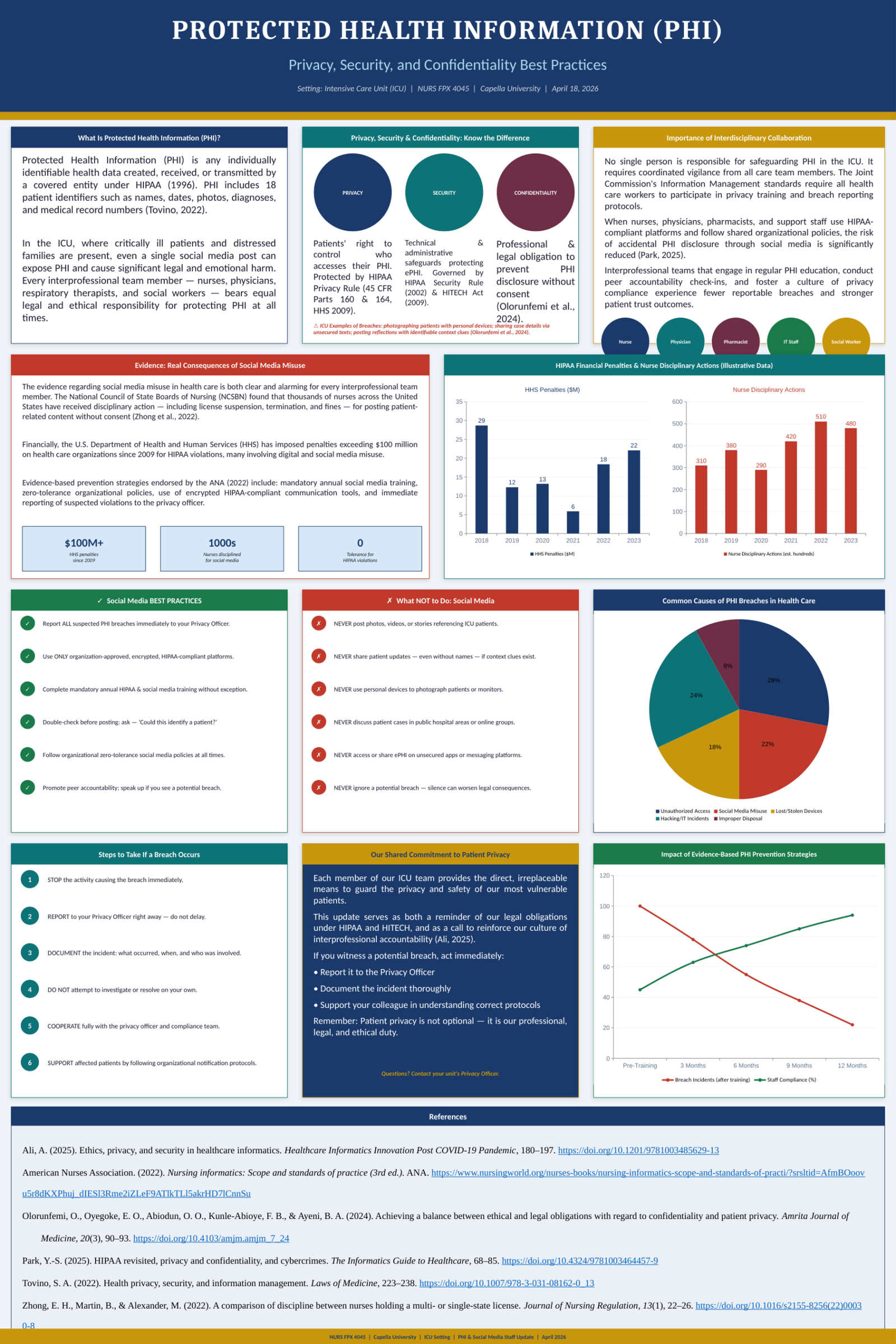
By definition, Protected Health Information (PHI) is any individual’s identifiable health information created, received or transmitted, in any form, be it electronic, written or oral, by a covered entity. PHI is protected under the Health Insurance Portability and Accountability Act of 1996 (HIPAA); there are 18 identifiers that identify patients (Tovino, 2022). In the intensive care unit, which has severely ill patients and families that are in strong emotional states, even one moment of posting on social media could expose your patient to PHI and potentially result in significant harm. Each member of the interprofessional team (nurses, physicians, respiratory therapists, and social workers) is equally legally and ethically responsible for protecting patients' PHI at all times.
Privacy, Security, and Confidentiality: Know the Difference
According to legislation established by the HIPAA Privacy Rule (HHS, 2009), patients have a right to privacy by having control of who can access their personal health information. The HITECH Act of 2009 (HHS, 2009) established similar laws to protect electronic personal health information. The HIPAA Security Rule (2002) regulates technical and administrative safeguards that protect electronic personal health information from unauthorized access. Confidentiality, established through an individual's professional and legal obligations, requires professionals to not disclose patient information without the patient's express consent (Olorunfemi et al., 2024). In the ICU, specific examples of technology-related breaches of confidentiality are: taking photographs of patients with a personal camera or device; providing vague reflections about cases that contain identifiable context clues; and sharing patient-related updates via unsecured text messages in violation of the HITECH Act of 2009 (Olorunfemi et al., 2024).
Why Interdisciplinary Collaboration Is Essential
No one person is responsible for keeping Protected Health Information (PHI) safe in the Intensive Care Unit (ICU). Keeping PHI confidential in the ICU is a team effort and requires coordinated effort from all members of the care team. According to the Joint Commission standards of Information Management, all health care providers are required to participate in both privacy and security training, as well as the reporting of breaches. When nurses, doctors, pharmacists, and other key staff use HIPAA-compliant platforms to communicate with each other and follow the same policies for their organization, the chances of accidentally disclosing PHI through social media will be reduced (Park, 2025). Engaging regularly in PHI education, conducting peer accountability check-ins, and creating a culture within interprofessional teams that supports compliance with privacy laws is associated with reduced incidents of reportable breaches and improved patient trust.
Evidence: Real Consequences of Social Media Misuse
The evidence regarding the improper use of social media in health care is alarming and should be a wake-up call for every member of the interprofessional team. The National Council of State Boards of Nursing found that thousands of nurses in the United States received disciplinary action (suspension of their licenses, termination of employment, fines, etc.) because they posted patient-related information without the patient's permission (Zhong et al., 2022). Financially, HHS has imposed fines in excess of $100 million on medical organizations since 2009 for HIPAA violations, many involving digital and social media violations. The ANA supports the use of evidence-based preventive strategies that include: mandatory annual training in the use of social media, organizational policies that have a zero tolerance for violations, the use of encrypted communications tools that comply with HIPAA regulations, and the reporting of suspected HIPAA violations to the privacy officer immediately after they have occurred.
Our Shared Commitment to Patient Privacy
Each person who is part of our Intensive Care Unit (ICU) provides the direct, irreplaceable physical means to guard the privacy and safety of our most vulnerable patients. As an update to our employees, this serves as a reminder of the legal obligations required by both the Health Insurance Portability and Accountability Act (HIPAA) as well as the Health Information Technology for Economic and Clinical Health Act (HITECH) and as a call for us to reinforce our culture of interprofessional accountability (Ali, 2025). If you see a potential breach in privacy, take immediate action; report it to your privacy officer, document it, and help the employee in understanding the appropriate course of action.
References
Ali, A. (2025). Ethics, privacy, and security in healthcare informatics. Healthcare Informatics Innovation Post COVID-19 Pandemic, 180–197. https://doi.org/10.1201/9781003485629-13
American Nurses Association. (2022). Nursing informatics: Scope and standards of practice (3rd ed.). ANA. https://www.nursingworld.org/nurses-books/nursing-informatics-scope-and-standards-of-practi/?srsltid=AfmBOoovu5r8dKXPhuj_dIESl3Rme2iZLeF9ATlkTLl5akrHD7lCnnSu
Olorunfemi, O., Oyegoke, E. O., Abiodun, O. O., Kunle-Abioye, F. B., & Ayeni, B. A. (2024). Achieving a balance between ethical and legal obligations with regard to confidentiality and patient privacy. Amrita Journal of Medicine, 20(3), 90–93. https://doi.org/10.4103/amjm.amjm_7_24
Park, Y.-S. (2025). HIPAA revisited, privacy and confidentiality, and cybercrimes. The Informatics Guide to Healthcare, 68–85. https://doi.org/10.4324/9781003464457-9
Tovino, S. A. (2022). Health privacy, security, and information management. Laws of Medicine, 223–238. https://doi.org/10.1007/978-3-031-08162-0_13
Zhong, E. H., Martin, B., & Alexander, M. (2022). A comparison of discipline between nurses holding a multi- or single-state license. Journal of Nursing Regulation, 13(1), 22–26. https://doi.org/10.1016/s2155-8256(22)00030-8