
Samples / Disaster Recovery Plan
Assessment 3: Disaster Recovery Plan
Visual Preview
Click the preview to enlarge it. The sample text continues below.
NURS FPX 4055 · Assessment 3 · Lake Park
Sample for study and reference. Ace My Assessment is an independent academic support service.
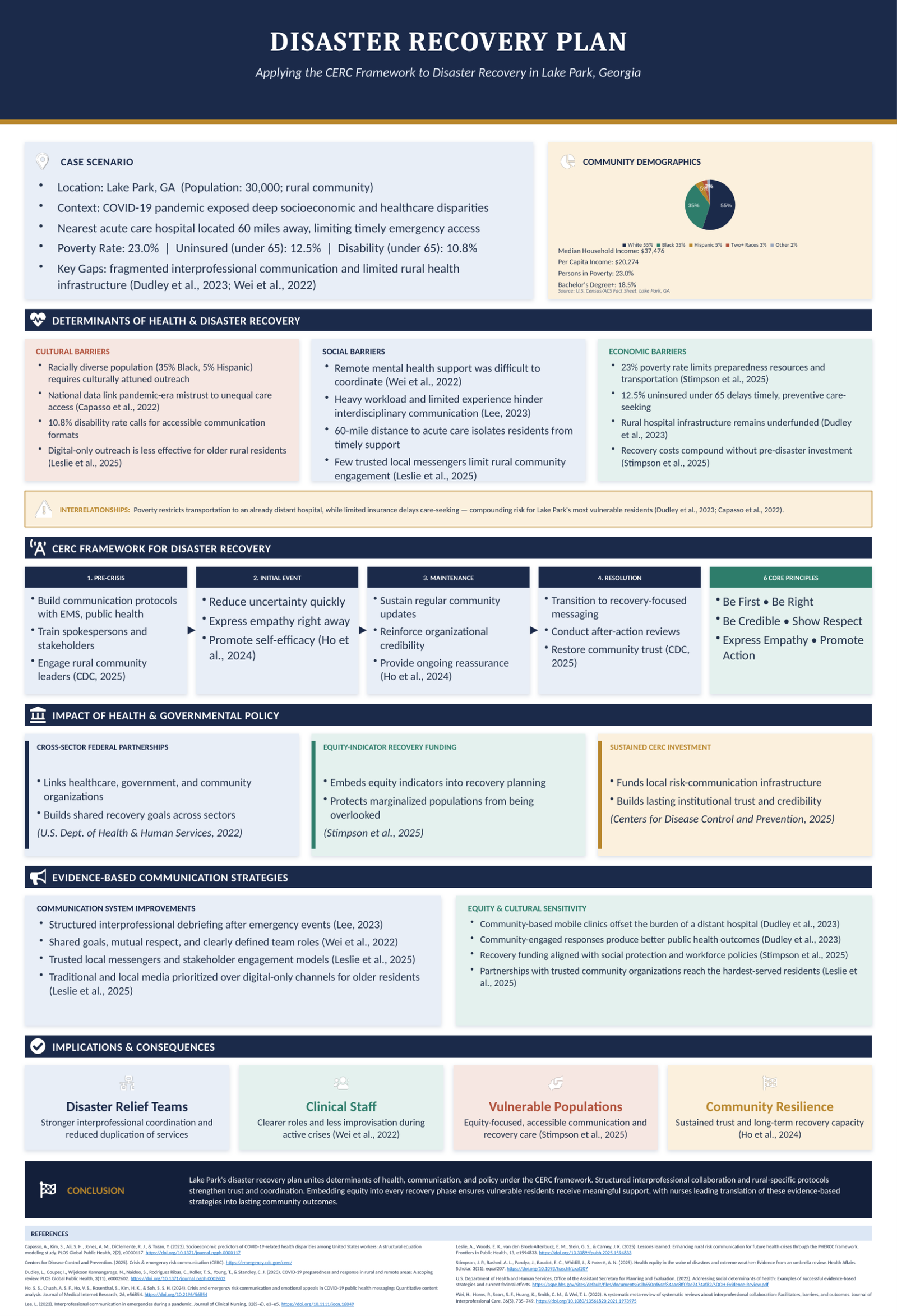
To ensure effective disaster recovery planning, it is important to understand the factors within the community that influence health, safety and resilience. Lake Park, Georgia, is a small rural community with a population of 30,000 people, who are highly vulnerable socio-economically (Stimpson et al., 2025). This plan focuses on addressing communication barriers, health disparities and inter-professional working during recovery, in line with the CERC framework. Nurses have a pivotal leadership position in the process of translating these principles to action and community-based disaster recovery plans.
Determinants of Health and Barriers to Safety and Recovery
Community experiences, responses, and recovery to disasters are influenced by multiple determinants of health. Lake Park residents live within a twenty-three percent poverty rate and have a distance of sixty miles to acute care (Stimpson et al., 2025). Disaster response responses are often consistently poor in rural areas with inadequate health system infrastructure (Dudley et al., 2023). These economic and geographic factors directly contribute to the overall vulnerability of the community to the health effects of disasters.
Significant economic challenges exist in Lake Park, and cultural and social barriers to these economic hardships are further obstacles. One-quarter of all those under the age of 65 are still not insured, and as a result, have delayed access to care (Stimpson et al., 2025). There is a strong national correlation between lower socioeconomic status and poor access to health care and poor health outcomes from the pandemic (Capasso et al., 2022). It is critical, then, to address these social and cultural obstacles to create real, sustained disaster resilience in a community.
Interrelationships Among Health Determinants and Barriers
These determinants and barriers do not function alone but rather act in synergy and are very influential. An already distant regional hospital (Dudley et al., 2023) is made even more difficult because of poverty's restrictions on transportation. Lack of adequate insurance coverage also can make people put off seeking care at an early stage, resulting in escalating preventable conditions during the active disaster event (Capasso et al., 2022). Being mindful of these inter-relationships, nurses can develop recovery strategies that target underlying causes instead of individual symptoms.
Communication Strategies and Interprofessional Collaboration
Coordinated, timely and clear communication between interprofessional healthcare team members is vital to effective disaster recovery. Staff interviews found that in the response to the pandemic, mental health support was challenging to coordinate remotely (Wei et al., 2022). In long-term public health emergencies, interdisciplinary communication is often hindered by a heavy workload and a lack of experience (Lee, 2023). The documented barriers identified indicate the importance of having structured and evidence-based interprofessional communication strategies in place during a future disaster.
Interprofessional healthcare teams are best supported by structured models of collaboration that have repeatedly been shown to decrease communication breakdowns. Shared goals, mutual respect, and clear team roles, are all facilitators of successful interprofessional collaboration (Wei et al., 2022). The discipline will discuss the concerns raised by each other after the emergency events through regular debriefs (Lee, 2023). These organized approaches could have a significant impact on improving interprofessional disaster response team working in Lake Park.
Structured Interprofessional Protocols for Rural Settings
Communication protocols are developed for rural communities to cater to their particular geographical and resource limitations. The PHERCC framework focuses on the role of trusted local messengers and stakeholder engagement to effectively communicate with vulnerable rural populations (Leslie et al., 2025). Digital-only media was less effective than traditional media or local sources for engaging older rural people (Leslie et al., 2025). This stakeholder-driven approach would improve interprofessional cooperation and enhance community confidence during all aspects of the recovery process at Lake Park.
The CERC Framework and the Impact of Health and Governmental Policy
The CERC framework offers a coherent, evidence-based and structured way of communicating during public health crises. According to Ho et al (2024), the elements of CERC are: showing empathy, encouraging action, and building credibility among the organization in every phase of disaster. Organizations can minimize uncertainty and promote public trust when dealing with fast-changing crisis scenarios by applying these principles (Ho et al., 2024). This plan supports and guides the communication between Lake Park Hospital and residents during this recovery process.
Health and governmental policies get a firm grip on each and every step of disaster recovery work. Federal efforts have increased to include partnerships across multiple sectors, between healthcare, government and community organizations (U.S. Department of Health and Human Services, 2022). If policies do not support effective communication infrastructure in historically underserved rural areas, it won't be able to effectively reach them (U.S. Department of Health and Human Services, 2022). The policy-practice link is evidence of the need for true government investments and institutional support in the implementation of CERC.
Policy-Driven Trust and Institutional Credibility
Consistent and sustained policy and funding will be crucial to institutional credibility in any public health crisis. Clear and consistent institutional messages, accompanied by emotional appeals, greatly enhanced public trust during pandemic communication efforts (Ho et al., 2024). Investment in local risk communication infrastructure directly supports community trust in risk communication during recovery (Centers for Disease Control and Prevention, 2025). Policy investment, in other words, is crucial to a credible and trustworthy communication during the disaster recovery process of Lake Park.
Social Justice, Health Disparities, and Access to Community Services
A properly developed disaster recovery plan can have a significant impact on the long-standing inequity in highly vulnerable communities. Incorporating equity indicators within the recovery planning process ensures that there is enough attention and resources to address the needs of marginalised populations (Stimpson et al., 2025). The lack of a regional hospital in Lake Park may contribute to the burden of care, with community-based mobile clinics being able to help alleviate this issue (Dudley et al., 2023). This equity-driven approach directly addresses inequities most likely to grow in the future if a community suffers a disaster.
To enhance access to community services, the structural barriers identified during this disaster recovery assessment need to be addressed. Engaging community through community-based responses in public health crises leads to improved health outcomes (Dudley et al., 2023). Costs of inequity are compounded after disasters if public health infrastructure is not in place before the disaster happens (Stimpson et al., 2025). The investments would significantly enhance the available healthcare services currently available to Lake Park residents based on evidence.
Equity-Oriented Recovery Implementation
To make these principles a reality, there needs to be specific, tangible measures in Lake Park's disaster recovery plan. Funding for recovery in alignment with social protection and workforce strengthening policies helps to increase the long-term sustainability of community resilience (Stimpson et al., 2025). There are structural barriers to recovery services that are best served by partnering with trusted community organizations (Leslie et al., 2025). This implementation strategy directly contributes to social justice and builds the Lake Park disaster recovery capacity.
Conclusion
The determinants of health, communication barriers, and existing policy gaps need to be addressed together in the disaster recovery plan for Lake Park. CERC application combined with interprofessional collaboration strategies will increase collaboration and trust in future disasters. Making equity part of every phase of recovery means supporting and providing vulnerable residents with truly meaningful support and resources. Nurses continue to play a key role in helping to implement these evidence-based strategies to achieve sustainable community health and safety outcomes.
References
Capasso, A., Kim, S., Ali, S. H., Jones, A. M., DiClemente, R. J., & Tozan, Y. (2022). Socioeconomic predictors of COVID-19-related health disparities among United States workers: A structural equation modeling study. Public Library of Science Global Public Health, 2(2), e0000117. https://doi.org/10.1371/journal.pgph.0000117
Centers for Disease Control and Prevention. (2025). Crisis & emergency risk communication (CERC). https://emergency.cdc.gov/cerc/
Dudley, L., Couper, I., Wijekoon Kannangarage, N., Naidoo, S., Rodriguez Ribas, C., Koller, T. S., Young, T., & Standley, C. J. (2023). COVID-19 preparedness and response in rural and remote areas: A scoping review. PLOS Global Public Health, 3(11), e0002602. https://doi.org/10.1371/journal.pgph.0002602
Ho, S. S., Chuah, A. S. F., Ho, V. S., Rosenthal, S., Kim, H. K., & Soh, S. S. H. (2024). Crisis and emergency risk communication and emotional appeals in COVID-19 public health messaging: Quantitative content analysis. Journal of Medical Internet Research, 26, e56854. https://doi.org/10.2196/56854
Lee, L. (2023). Interprofessional communication in emergencies during a pandemic. Journal of Clinical Nursing, 32(5–6), e3–e5. https://doi.org/10.1111/jocn.16049
Leslie, A., Woods, E. K., van den Broek-Altenburg, E. M., Stein, G. S., & Carney, J. K. (2025). Lessons learned: Enhancing rural risk communication for future health crises through the PHERCC framework. Frontiers in Public Health, 13, e1594833. https://doi.org/10.3389/fpubh.2025.1594833
Stimpson, J. P., Rashed, A. L., Pandya, J., Baudot, E. C., Whitfill, J., & Ortega, A. N. (2025). Health equity in the wake of disasters and extreme weather: Evidence from an umbrella review. Health Affairs Scholar, 3(11), eqxaf207. https://doi.org/10.1093/haschl/qxaf207
U.S. Department of Health and Human Services, Office of the Assistant Secretary for Planning and Evaluation. (2022). Addressing social determinants of health: Examples of successful evidence-based strategies and current federal efforts. https://aspe.hhs.gov/sites/default/files/documents/e2b650cd64cf84aae8ff0fae7474af82/SDOH-Evidence-Review.pdf
Wei, H., Horns, P., Sears, S. F., Huang, K., Smith, C. M., & Wei, T. L. (2022). A systematic meta-review of systematic reviews about interprofessional collaboration: Facilitators, barriers, and outcomes. Journal of Interprofessional Care, 36(5), 735–749. https://doi.org/10.1080/13561820.2021.1973975