Samples / NURS FPX 8022 / Assessment 4
Quality Improvement Project Plan Using Informatics/Technology
NURS FPX 8022 · Assessment 4
Sample for study and reference. Ace My Assessment is an independent academic support service.
A Doctor of Nursing Practice (DNP) nurse must be able to utilize information from quality data to create technological solutions to improve the situation. The medication administration safety and hand hygiene performance gaps were revealed in Cleveland Clinic's publicly reported performance data, as part of the Leapfrog and Medicare Compare initiatives. To address these specific gaps, it was proposed that there be an evidence-based technology solution that incorporated barcode medication administration integrated with clinical decision support. The application of the SAFER Guides and the subsequent development of a risk mitigation plan further outlined the risks which need to be properly managed. This quality improvement project plan is a summary of the findings above, and will be used as a comprehensive plan for action to achieve technology-enabled practice change.
This paper shows that a systematic, evidence-based approach to implementing technology has the potential to measurably contribute to patient safety improvement at Cleveland Clinic. The next sections cover problem description and significance, technology solution and plan and implementation. Other sections cover the leadership in leading change and the redesign of the workflow in order to facilitate this quality improvement effort. The narrative is supplemented with visual process maps showing current and proposed medication administration process in Appendices. These elements provide a comprehensive framework for improving the medication safety performance in a sustainable way at this organization.
This plan is based on a data-driven methodology, incorporating results of formal safety assessments, structured risk analysis and evidence-based literature. All recommendations are based on triangulated evidence from Leapfrog data and Medicare Compare data, SAFER Guide self-assessment, and peer-reviewed nursing informatics research. This methodical approach guarantees that recommendations are based on organizational facts and figures and not on assumption or anecdote. What emerges is a quality improvement plan that's sensible, evidence-based and not just a discussion.
Problem, Significance, and Impact
The main issue tackled in this project is the lack of uniformity in safety practices for medication administration in an acute care hospital. The Leapfrog Group's overall Hospital Safety Grade for Cleveland Clinic's main campus was assigned an overall grade of C for the Spring 2026 reporting period. This grade is based on certain process shortcomings, such as a safe medication administration score of 15 out of 100. The Leapfrog Group data (2026) also identify that hospitals with below average scores for medication administration are at higher risk for preventable adverse drug events. The results of these findings make medication administration safety the priority problem for this quality improvement effort.
This problem has serious implications for various groups of stakeholders involved in and outside the organization. Executive leadership is exposed to reputational and financial risks – because reported safety grades directly impact patient choice and contracts with payers. Immediate effects of medication errors are felt by clinical departments and nursing staff, such as the distress and guilt of preventable patient harm. Legal counsel and IT departments also need to deal with the implications of any medication safety technology gaps, along with the technical aspects. This requires co-ordinated attention from clinical, technical, legal and executive stakeholders.
Supporting Data from Leapfrog and Medicare Compare
The objective of this quality improvement project is to be based on a publicly reported performance data that will be relevant to the project's stakeholders. Cleveland Clinic also earned a low score on the handwashing measure (15 out of 100) compared to the national average (The Leapfrog Group, 2026). Medicare's Care Compare tool also showed up the hospital's overall quality rating including a measure group relevant to this project that is part of the Safe Care measure (Centers for Medicare & Medicaid Services, 2026). Leapfrog grades for hospitals in the region were similar, indicating this issue is part of a larger systemic issue that isn't a problem with a specific hospital (Crain's Cleveland Business, 2026). When viewed collectively, this information reveals the need and wider importance of this quality improvement effort.
Consequences of an Unaddressed Problem
If left unchecked, this issue can have an escalating clinical, financial and reputational impact over time. If medication administration scores continue to be low, additional declines in grades may impact patient volumes and payment negotiations with payers. Medications errors can also cause serious harm to patients, lawsuits and lower nurse morale if not prevented. A nurse who was prosecuted for a fatal medication error is a perfect example of how stringent system-level risks can become if they are not addressed (Townley et al., 2022). The interrelated risks highlight the need to take a proactive approach to addressing this issue through planned and systematic quality improvement.
Technology/Informatics Solution
The project's technology solution is clearly framed and directly solves the identified gaps in medication safety. The compelling vision is a process for medication administration that ensures every dose is verified electronically prior to administration to the patient. Medication administration using Barcode technology along with clinical decision support will be the technology solution of the core. Integrated systems that include both barcode verification and decision support have been shown to have significant impact in reducing medication administration errors (Gauthier-Wetzel, 2022). This technology directly addresses the identified process failures using performance data from Leapfrog and Medicare Compare.
This technology revolutionizes the way meds are administered by putting the safety check directly into the nursing process. Nurses will check the medication bar code against the patient's wrist band and then the system will verify if there is a match. Predictive clinical decision support will also perform allergy checks, order checking, and high-risk medication checking prior to dispensing. SCDSS is a tool that can be shown to support clinical judgment and decrease the need for manual verification alone (Hants et al., 2023). This process change will move the medication safety process from manual and error prone to structured and technology assisted.
Data Points for Monitoring Improvement and Sustainability
It is essential that there are clear data points to track progress, and to guide further development and refinement of this technology, if this is to be sustained. First, the compliance rate of bar code scanning will be monitored monthly in the different nursing units to monitor dual scanning compliance. Second, the rate of override for clinical decision support will be tracked, with the aim of detecting alert fatigue and making adjustments to alert thresholds. Third, Leapfrog safe medication administration and handwashing scores will be measured on an annual basis to ensure that measurable organizational-level improvement is achieved. These three data points together give a holistic, measurable format to evaluate this technology's effectiveness and sustainability as it continues to develop.
Relevance of the Proposed Solution to the Identified Problem
This technology solution was chosen because it correlates directly with the process failure(s) observed in performance data. The low Leapfrog medication administration score is due to inconsistencies in point-of-care verification, and as a result, barcodes directly address this issue by requiring dual verification at the point of medication administration. Clinical decision support also aims towards alert associated risks discovered throughout the SAFER Guide self-assessment in the past course phase. The safety benefits of technology solutions that have been aligned closely to an identified technology gap are measurable (Sittig et al., 2025). The proximity of a problem and a solution increases the chances of positive, lasting change.
Implementation Plan and Challenges
Careful consideration of challenges associated with logistics, people, and resources will be required to implement this technology solution. However, before reliable scanning of barcodes can be maintained, these factors must be addressed for both the logistics of getting the old handheld scanners and the wireless connectivity. In respect of personnel, trained and structured support of nursing staff will be needed to enable them to adhere to the scan consistently. Results of the risk mitigation plan identified equipment failure as a major contributor to manual override, among nursing staff. The logistical and personnel issues need to be addressed at the outset for successful and sustained technology uptake.
Financial and coordination issues are also important points to consider in the process of the implementation. A dedicated capital investment and continuous help from the IT department will be needed to upgrade the scanning equipment and deploy an analytics dashboard. To successfully setup and manage clinical decision support alerts, coordination will be necessary with the nursing, pharmacy and informatics departments. Inconsistent alert override justification was identified as a key risk in the risk mitigation plan that needed cross-departmental accountability structures (Wang et al., 2022). Preemptively tackling these financial and coordination issues will help facilitate a more seamless and sustainable technology implementation process.
Workflow Redesign Team and Ethical Considerations
A cross-functional workflow redesign team will be crucial to ensure this implementation runs smoothly across departments. This should consist of Bedside Nurses, Pharmacy Staff, IT Informatics Staff, and a Nursing Informatics Officer to inform the decisions of configuration. Ethical issues have to do with providing equal training opportunities to all shifts and not giving punitive measures for early implementation mistakes. A just culture perspective, not a punitive approach, is known to support the reporting of honest errors when transitioning to new technologies (Townley et al., 2022). This implementation will need to be ethical and feasible, so including a variety of frontline and technical points of view will help achieve this.
Leader Role in Change Management
The leadership and influence of strong leaders will be critical to leading this technology-based practice change effectively. The Chief Nursing Officer and Chief Nursing Informatics Officer will be the key sponsors, championing the importance of and vision for the initiative. Frontline charge nurses and pharmacy leaders will be empowered to support the new expectations for scanning and override, on a daily basis. Leadership-driven, structured communication has been proven to make a difference in the engagement of staff when it comes to large-scale technology change projects (Lindsay, 2023). A hierarchy of leadership provides a consistent message, from executive sponsorship to day-to-day practice.
An evaluation of the readiness of the organization identifies significant strengths and areas that are relevant with regard to this implementation. Supporting this change are Cleveland Clinic's current EHR system and the workflow of pharmacists verifying drug orders. Nursing time pressure, alert fatigue and equipment reliability is inconsistent are identified barriers, all of which are documented in the previous risk mitigation plan. The change model was chosen in line with Kotter's 8 step change model, which has been found to encompass both creating urgency and embedding new safety behaviours in the long term (Lindsay, 2023). This is a description of the organization's strengths and barriers which is used to inform a realistic, evidence-based change management approach.
Communication Plan for Executive Leadership and the Board
A communication plan that is organized will be needed to obtain and maintain executive support for this initiative. The Executive leadership and the Board will be provided quarterly summaries of Leapfrog scores, override rates, and trends in scanning compliance. These will clearly tie technology investments to tangible gains in patient safety and brand. Data-driven, transparent communication has been demonstrated to make for more durable executive support within large-scale health care technology programs (Lindsay, 2023). This continual process of communication will help support leadership engagement throughout the entire implementation timeline.
Rationale for Selecting Kotter's Change Model
Choosing an appropriate change management model involved considering multiple existing models of change management deemed suitable for this project. Although the three-stage model is useful for its simplicity, it does give as much structure to sustaining change on a multi-unit basis within the hospital. The 8-step process of Kotter was chosen as it will explicitly focus on creating coalitions, communicating, and establishing long-term support for new practices. Such a model has been used to successfully implement nursing change efforts that are technology-influenced and complex in large academic health systems (Lindsay, 2023). This is because Kotter's model is considered most appropriate to this particular multi-department technology implementation as it frames the rationale.
Workflow
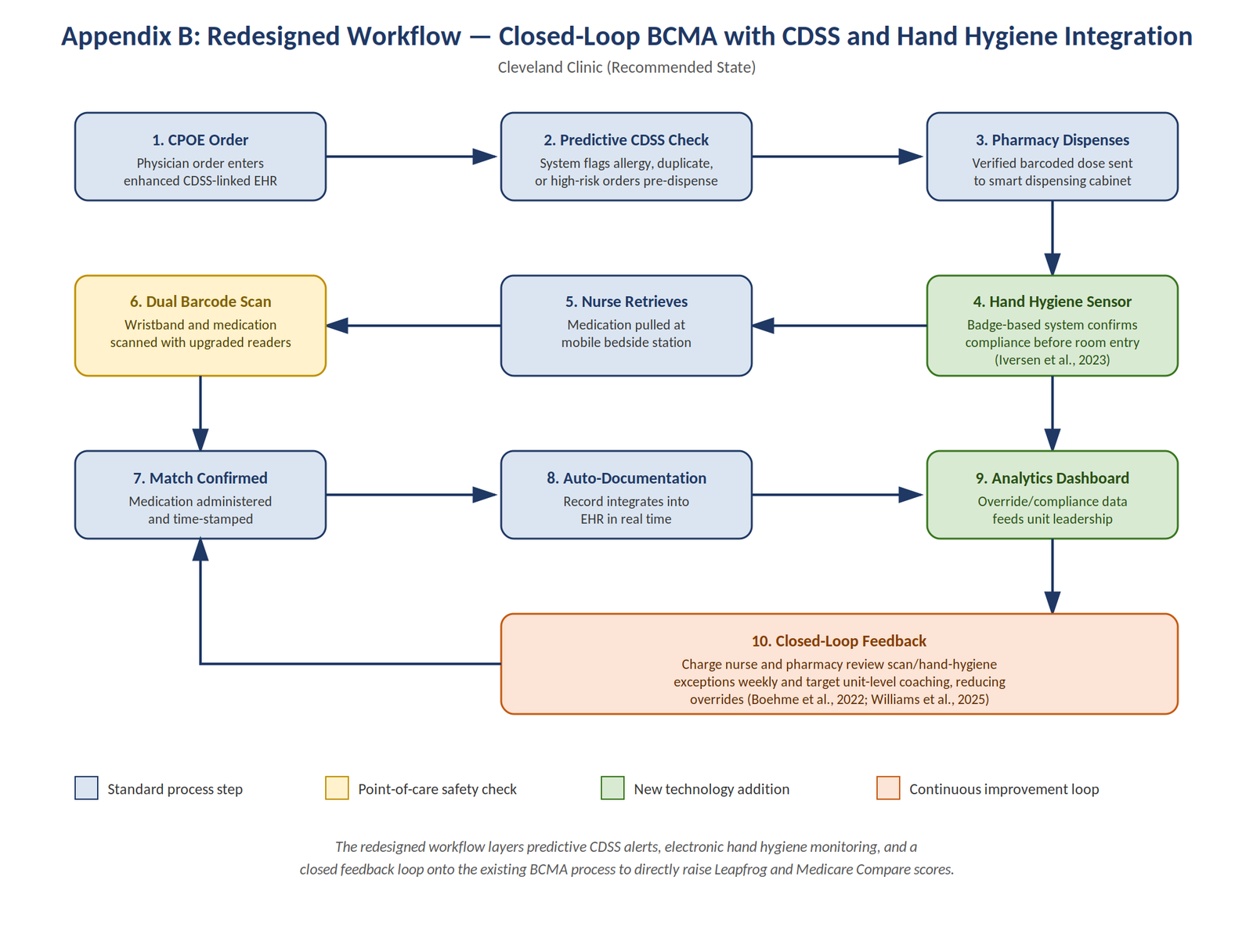
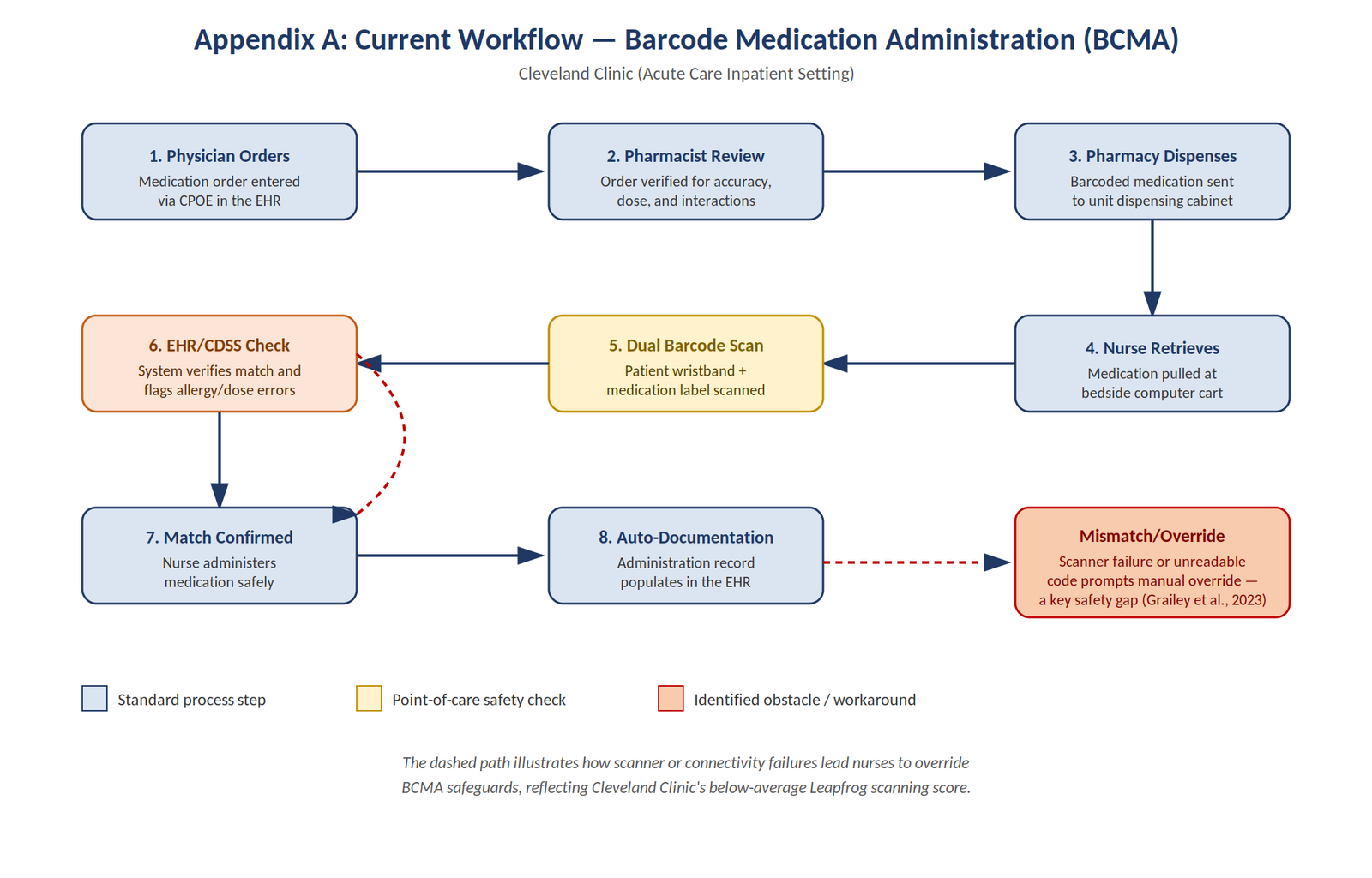
The existing medication administration process shown in Appendix A is a predictable, but fragile, process for administering medication. The orders are entered electronically by the physicians, verified for accuracy by pharmacists and scanned by the nurses upon receipt of the bar-coded medication and the patient's wristband prior to administration. One of the inefficiencies is that if there is a scanner problem or if it is out of range, nurses are forced to go into manual override to verify the order. The override step is a non-value added workaround that avoids the very safety check the technology was intended to provide (Grailey et al., 2023). This vulnerability is shown in Appendix A, where a picture will help you understand where the breakdown points currently weaken the safety of medication administration. The new workflow (Appendix B) addresses these vulnerabilities with extra layers of technology-based safety. In the future, predictive clinical decision support (CCDS) will pre-screen and “double-check” orders before they are issued, thereby providing a value-added check at the front end of the order entry process. The lack of structured monitoring identified in the risk mitigation plan is addressed by an integrated analytics dashboard and closed-loop feedback process. In large healthcare systems, structured real-time feedback has been effective in helping to maintain the meaningful reduction of override rates (Boehme et al., 2022). Each additional step in Appendix B enhances the medication administration process rather than complicates it.
Value-Added and Non-Value-Added Process Steps
When the value-added versus non-value added steps can be identified, it becomes clear where this workflow redesign adds value. Value-added features directly contribute to medication safety such as Pharmacist Verification, Dual Barcode Scanning and the Predictive Decision Support Screening. The manual override and the undocumented alert dismissals are non-value added steps that require time but do not improve patient safety. Removing non-value-added override steps has been found to measurably improve medication safety performance in similar healthcare systems (Boehme et al., 2022). This distinction helps to continually improve the workflow until steps are made that truly serve to protect patients and not just meet procedural needs.
Summary: Final Recommendations and Conclusions
This quality improvement project plan is a translation of performance data to a structured, evidence-based pathway to patient safety improvement. Barcode medication administration, when paired with clinical decision support, directly tackles the medication safety deficiencies found in Leapfrog and Medicare Compare information. Realistic and sustainable technology implementation is facilitated by structured implementation planning, leadership involvement, and Kotter's change management model. The accompanying appendices show redesigned workflows that have been shown to measurably improve existing, vulnerable medication administration processes. These improvements will continue to be achieved through ongoing monitoring of scanning compliance, override rates and Leapfrog performance.
Finally, it is important that this plan is viewed as a continuous process rather than a single event and is continually based on data. These strategies should be updated and improved periodically, as these compliance and override rates will be reviewed and as Leapfrog is reviewed. The continuing engagement of leadership and on-floor nurses will continue to be critical in maintaining the enhancements identified throughout this plan. This quality improvement plan provides a plausible strategy for the long-term achievement of patient safety improvements through continued focus and adaptation based on evidence.
References
Boehme, S., Wohlt, P., Valentine, J., & Ensign, R. (2022). Sustained barcode medication administration rates less than 2 percent in a large healthcare system. Journal of Patient Safety and Risk Management, 27(6), 268–274. https://doi.org/10.1177/25160435221137145
Centers for Medicare & Medicaid Services. (2026). Cleveland Clinic – Care Compare. U.S. Department of Health and Human Services. https://www.medicare.gov/care-compare/details/hospital/360180
Crain's Cleveland Business. (2026, May 6). Cleveland Clinic, University Hospitals safety rankings. https://www.crainscleveland.com/health-care/ccl-cleveland-clinic-university-hospitals-safety-rankings-20260505/
Gauthier-Wetzel, H. E. (2022). Barcode medication administration software technology use in the emergency department and medication error rates. CIN: Computers, Informatics, Nursing, 40(6), 382–388. https://doi.org/10.1097/CIN.0000000000000846
Grailey, K., Hussain, R., Wylleman, E., Ezzat, A., Huf, S., & Dean Franklin, B. (2023). Understanding the facilitators and barriers to barcode medication administration by nursing staff using behavioural science frameworks: A mixed methods study. BMC Nursing, 22, e378. https://doi.org/10.1186/s12912-023-01382-x
Hants, L., Bail, K., & Paterson, C. (2023). Clinical decision-making and the nursing process in digital health systems: An integrated systematic review. Journal of Clinical Nursing, 32(19–20), 7010–7035. https://doi.org/10.1111/jocn.16823
Lindsay, M. (2023). A shared governance approach to nursing documentation redesign using Kotter's change management model. Nursing Management, 54(3), 14–20. https://doi.org/10.1097/01.NUMA.0000919064.29246.6b
Sittig, D. F., Flanagan, T., Sengstack, P., Cholankeril, R. T., Ehsan, S., Heidemann, A., Murphy, D. R., Salmasian, H., Adelman, J. S., & Singh, H. (2025). Revisions to the Safety Assurance Factors for Electronic Health Record Resilience (SAFER) Guides to update national recommendations for safe use of electronic health records. Journal of the American Medical Informatics Association, 32(4), 755–760. https://doi.org/10.1093/jamia/ocaf018
The Leapfrog Group. (2026, May 6). Cleveland Clinic Foundation – OH – Hospital Safety Grade. https://www.hospitalsafetygrade.org/h/cleveland-clinic-foundation
Townley, J. N., Pogue, C. A., & McHugh, M. D. (2022). Criminal prosecution of clinician errors: A setback to the progress toward safe hospital work environments. Journal of Hospital Medicine, 17(10), 850–853. https://doi.org/10.1002/jhm.12952
Wang, L., Goh, K. H., Yeow, A., Poh, H., Li, K., Yeow, J. J. L., Tan, G., & Soh, C. (2022). Habit and automaticity in medical alert override: Cohort study. Journal of Medical Internet Research, 24(2), e23355. https://doi.org/10.2196/23355
Appendix A
Current Workflow: Barcode Medication Administration
Appendix B
Redesigned Workflow: Closed-Loop BCMA with CDSS and Hand Hygiene Integration