Samples / NURS FPX 8022 / Assessment 1
Using Data to Make Evidence-Based Technology Recommendations
NURS FPX 8022 · Assessment 1
Sample for study and reference. Ace My Assessment is an independent academic support service.
Technology is becoming one of the most critical assets in the healthcare field for safeguarding patient safety and improving measurable safety outcomes in acute care environments. This paper will explore Cleveland Clinic, an academic acute care hospital in Cleveland, OH as the chosen practice environment for this assessment. This organization uses a barcode medication administration system coupled with clinical decision support, which directly influences a number of publicly reported quality indicators. The data from Leapfrog and Medicare Care Compare are analyzed here to determine what areas of current safety performance and where targeted improvement is needed. This evaluation ultimately recommends a technology enhancement with evidence that will bolster both Leapfrog and Medicare Compare performance scores.
Benefits of Barcode Medication Administration Technology
The evolution of nursing technology keeps changing the way that clinicians provide accurate and accountable patient care in a timely manner. In Cleveland Clinic, barcode medication administration is built into the EHR for accuracy at the bedside. This system must be used to scan a patient's wristband and the medication's barcode before giving any medication to a patient. Studies have shown that medication administration errors can be significantly reduced by the use of a barcode when using a barcode scanner in a variety of acute inpatient care settings (Gauthier-Wetzel, 2022). Overall, this is a basic piece of technology that continues to be an important piece of technology for safe medication practices in the inpatient care continuum.
In addition to the decrease in errors, barcode medication administration provides other benefits that are far-reaching in the nursing process and accountability systems. The system creates documentation in real time that helps to minimize manual charting and ensure the accuracy of medication administration records. Integrated alerts also alert nurses to allergy conflicts, duplicate orders and/or incorrect doses before patient harm. Scanning consistently has been demonstrated to maintain lower override rates in large, multi-hospital healthcare systems (Boehme et al., 2022). These are all part of a larger goal to provide safe, high-reliability inpatient nursing care at Cleveland Clinic.
Obstacles to Utilizing Barcode Medication Administration Technology
The safety advantages of nursing are well known; however, there are barriers that inhibit consistent use of the bar code medication administration record (BAR). Nurses tend to skip steps when scanning during hectic shifts because of time constraints or too many patients to attend to. Alternatives to the wristband, like scanning a photocopy instead of the wristband, reduce this protection. Compliance with scans remains low for the nursing workforce despite extensive work flow education, as confirmed by qualitative research (Grailey et al., 2023). These barriers represent just a few of the reasons why a medication safety technology can fail to be successful when deployed in a clinical workflow.
Nursing staff report technical and environmental issues that affect the performance of barcode scanning in the bedside. Poor wireless signal, scanner malfunctions and damaged barcodes are recurring issues on busy units which disrupt the medication administration process. These interruptions also create an environment that fosters nurse frustration and staff override of safety prompts instead of troubleshooting with malfunctioning equipment. One study that followed a group over time showed that the rate of scanning was highly variable by hospital unit and decreased over time (Williams et al., 2025). Continued efforts to correct issues of equipment and workflow are critical for maintaining safe, standardized medication administration processes.
Current Workflow for Barcode Medication Administration
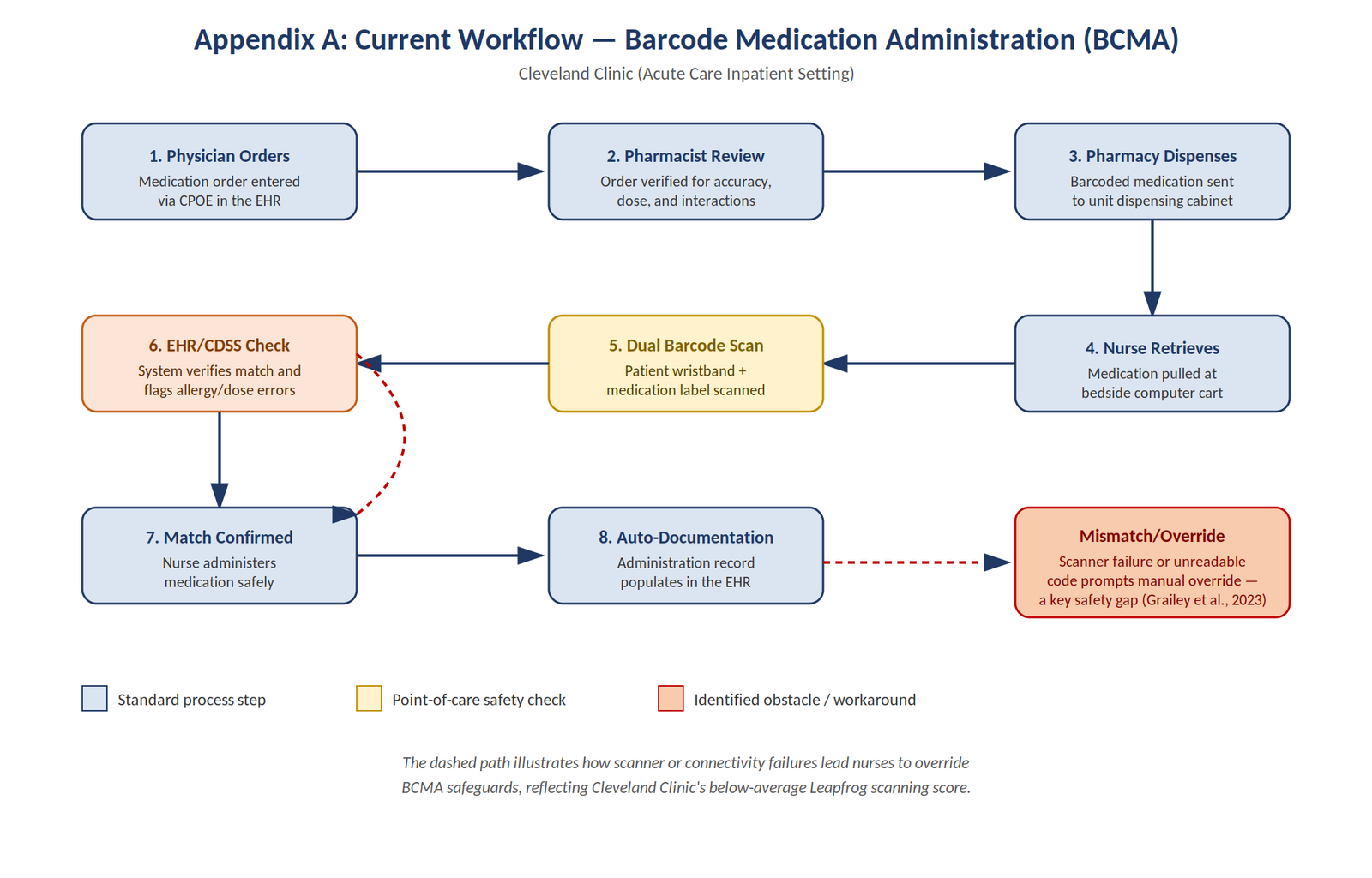
The Cleveland Clinic medication administration process at the present time is well-defined from the physician's order to the documentation by the nurse. Physicians place orders using the computer order entry system, pharmacists check the computer order for accuracy and pharmacists dispense barcoded medications to the unit. Then, nurses are able to scan the patient wristband and medication label together, and the electronic system verifies a safe match prior to administration. This structured sequence is similar to models of medication administration that are linked to reduced transcription and administration errors in the barcode system (Grailey et al., 2023). This process is shown in Appendix A as a visual representation of the different steps involved from the Order being entered to the Final Documentation.
Patient Safety Areas Identified
Leapfrog and Medicare Compare Performance Data
Performance data that are publicly reported offer a measure of the safety of Cleveland Clinic at its main campus. The Leapfrog Group gave Cleveland Clinic Foundation an overall Grade of C for the Spring 2026 reporting period. (The Leapfrog Group, 2026). Three patient safety areas are highlighted as examples of this grade: rates of healthcare-associated infections, safe medication administration, and hand hygiene practices. Both the hospital's infection composite scores (MRSA and C. difficile) were above the national average (The Leapfrog Group, 2026). The figures show specific areas of safety that need to be improved at this organization.
Even more significant safety gaps are identified by process-level measures at this hospital within the medication administration domain. The safe medication administration measure scored 15 points for Cleveland Clinic, which was below the national average of 86.14 points (The Leapfrog Group, 2026). In addition, the hospital received a handwashing score of 15 out of 100, which is lower than the national average of 78.21 (The Leapfrog Group, 2026). Both measures are directly related to the barcode medication administration technology and hand hygiene examined during this assessment. The poor process grades, along with the overall Leapfrog grade, contribute significantly to the reason for the overall drop in the score from previous reporting periods.
Another federally provided view of hospital-level patient safety performance comes from Medicare's Care Compare tool. The Centers for Medicare and Medicaid Services (Centers for Medicare & Medicaid Services, 2026) currently rates Cleveland Clinic Overall 5-stars for quality. This composite rating combines the measure group for Safety of Care with the mortality, readmission, and patient experience measure groups (Centers for Medicare & Medicaid Services, 2026). Regional acute care hospitals like University Hospitals Cleveland Medical Center and MetroHealth Medical Center were similarly rated with a C grade from the Leapfrog Group in the Spring 2026 report (Crain's Cleveland Business, 2026). The findings from this regional comparison indicate that problems with safety in medication administration and hand hygiene are not confined to one organisation.
Recommended Technology Implementation
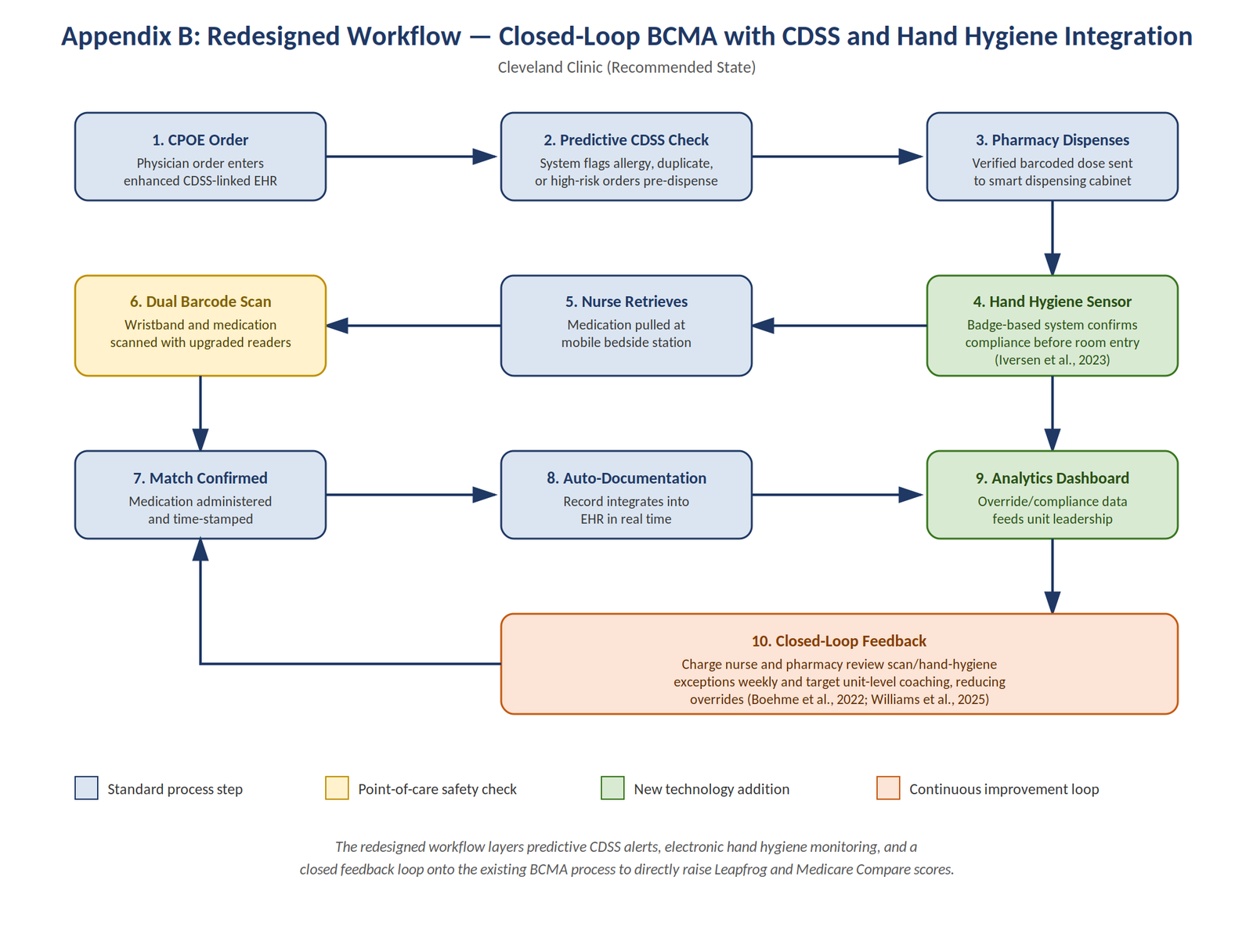
Performance data indicate a clear opportunity for improvement on both Leapfrog and Medicare Compare scores, through the use of technology. The introduction of predictive clinical decision support for the medication administration process score would have a direct positive impact on the medication administration process score (Boehme et al., 2022; Williams et al., 2025). Additionally, incorporating predictive decision support into digital nursing systems has been demonstrated to support clinical judgment and minimize error rates (Hants et al., 2023). This upgrade would also address the hospital's poor handwashing measure, when combined with an electronic hand hygiene monitoring system (Iversen et al., 2023). These technologies, which are evidence-based, collectively address the targeted process gaps that currently contribute to Cleveland Clinic's lower overall safety score.
Redesigned Workflow
The streamlined process is an extension of the current medication administration process with the inclusion of two new levels of protection. Orders are now screened before ordered and compliance is confirmed by electronic hand hygiene sensors instantly before entering the room. A closed-loop analytics dashboard also provides charge nurses and pharmacy leaders with a report of exceptions to scanning and hand hygiene that can be reviewed weekly for coaching (Boehme et al., 2022). This is a re-designed workflow, with each new technology component indicated relative to current practice, which is shown in Appendix B.
Conclusion
This evaluation illustrates the translation of the performance information to meaningful technology recommendations in a given acute care practice context. Medication safety and hand hygiene are areas of strength and opportunity for improvement identified by Cleveland Clinic's Leapfrog and Medicare Compare data. Although there are meaningful protection mechanisms that are already in place, with the barcode medication administration system, these protections are currently constrained by nursing workflow barriers and equipment challenges. This can be served by adding predictive decision support and electronic hand hygiene monitoring to this foundation to provide an evidence-based roadmap to a better score. As Cleveland Clinic strives to improve patient safety in all care settings, ongoing data-based assessment will be important to their efforts.
References
Boehme, S., Wohlt, P., Valentine, J., & Ensign, R. (2022). Sustained barcode medication administration rates less than 2 percent in a large healthcare system. Journal of Patient Safety and Risk Management, 27(6), 268–274. https://doi.org/10.1177/25160435221137145
Centers for Medicare & Medicaid Services. (2026). Cleveland Clinic – Care Compare. U.S. Department of Health and Human Services. https://www.medicare.gov/care-compare/details/hospital/360180
Crain's Cleveland Business. (2026, May 6). Cleveland hospitals receive mixed marks in latest Leapfrog patient safety rankings. https://www.crainscleveland.com/health-care/ccl-cleveland-clinic-university-hospitals-safety-rankings-20260505/
Gauthier-Wetzel, H. E. (2022). Barcode medication administration software technology use in the emergency department and medication error rates. CIN: Computers, Informatics, Nursing, 40(6), 382–388. https://doi.org/10.1097/CIN.0000000000000846
Grailey, K., Hussain, R., Wylleman, E., Ezzat, A., Huf, S., & Dean Franklin, B. (2023). Understanding the facilitators and barriers to barcode medication administration by nursing staff using behavioural science frameworks: A mixed methods study. BioMed Central Nursing, 22, e378. https://doi.org/10.1186/s12912-023-01382-x
Hants, L., Bail, K., & Paterson, C. (2023). Clinical decision-making and the nursing process in digital health systems: An integrated systematic review. Journal of Clinical Nursing, 32(19–20), 7010–7035. https://doi.org/10.1111/jocn.16823
Iversen, A. M., Hansen, M. B., Kristensen, B., & Ellermann-Eriksen, S. (2023). Clinical evaluation of an electronic hand hygiene monitoring system. American Journal of Infection Control, 51(4), 376–379. https://doi.org/10.1016/j.ajic.2022.06.017
The Leapfrog Group. (2026, May 6). Cleveland Clinic Foundation – OH – Hospital Safety Grade. https://www.hospitalsafetygrade.org/h/cleveland-clinic-foundation
Williams, R., Kantilal, K., Man, K. K. C., Blandford, A., & Jani, Y. (2025). Barcode medication administration system use and safety implications: A data-driven longitudinal study supported by clinical observation. British Medical Journal Health Care Informatics, 32(1). https://doi.org/10.1136/bmjhci-2024-101214
Appendix A
Current Workflow: Barcode Medication Administration
Appendix B
Redesigned Workflow: Closed-Loop BCMA with CDSS and Hand Hygiene Integration